
Yamaha Corporation
Japanese multinational musical instrument and audio equipment manufacturer.

via Wikipedia: Yamaha Corporation · see source
Yamaha Corporation is a Japanese multinational manufacturer of musical instruments and audio equipment. It is the world's largest musical instrument manufacturing company and a constituent of the Nikkei 225. Founded in 1887 as a reed organ manufacturer, the company was originally named Nippon Gakki Co., Ltd. and was renamed Yamaha Corporation in 1987, one hundred years after its first reed organ.
- founded
- 1887 (as Nippon Gakki Co., Ltd.)
- incorporated
- 12 October 1897
- field
- Musical instruments, audio equipment, semiconductors, industrial machinery
- nationality
- Japanese
- known_for
- World's largest musical instrument manufacturer; first commercially successful d
Verified Timeline
Lore & Background
Yamaha Corporation was established in 1887 by Torakusu Yamaha in Hamamatsu, Shizuoka Prefecture, as a reed organ manufacturer. After World War II, under president Genichi Kawakami, the company used its metallurgical expertise to manufacture motorcycles, leading to the YA-1 model in 1954 and the founding of Yamaha Motor Co., Ltd. in 1955. In 1987, the company was renamed Yamaha Corporation in honor of its founder, and its logo—a trio of interlocking tuning forks—reflects its origins.
Reader's Guide
Yamaha Corporation's significance lies in its dominance as the world's largest musical instrument manufacturer and its pioneering role in electronic music. In 1983, it released the Yamaha DX7, the first commercially successful digital synthesizer. The company also shipped the world's first CD recorder in 1988 and acquired notable brands such as Bösendorfer, Steinberg, and Sequential Circuits. Beyond instruments, Yamaha diversified into semiconductors, audio/visual equipment, sporting goods, and industrial robots. Its music education program, begun in 1954, led to the establishment of the Yamaha Music Foundation in 1966. The company's corporate mission is described by the Japanese word 'Kandō,' meaning the sensation of profound excitement and gratification from supreme quality and performance.
Did You Know?
- The YA-1 motorcycle, nicknamed 'Akatombo' (Red Dragonfly), was named in honor of founder Torakusu Yamaha.
- Yamaha shipped the world's first CD recorder in 1988.
- The company's logo—a trio of interlocking tuning forks—reflects its origins as a musical instrument manufacturer.
- Yamaha's corporate mission is described by the Japanese word 'Kandō,' meaning the sensation of profound excitement and gratification from supreme quality and performance.
Humble Beginnings in Hamamatsu
In 1887, Torakusu Yamaha established Nippon Gakki Co. in Hamamatsu, Shizuoka Prefecture, with a single focus: building reed organs. That century of growth culminated in 1987, when the firm was renamed Yamaha Corporation to honor its founder. The identity forged in those early decades still lives on in the corporate logo: three interlocking tuning forks, a quiet nod to the instrument-making roots that launched the enterprise. What began as a small regional workshop crafting reed organs grew, over more than a hundred years, into the world's largest musical instrument manufacturer, spanning pianos, silent pianos, drums, guitars, brass, woodwinds, strings, and vibraphones.
From War Machines to Red Dragonflies
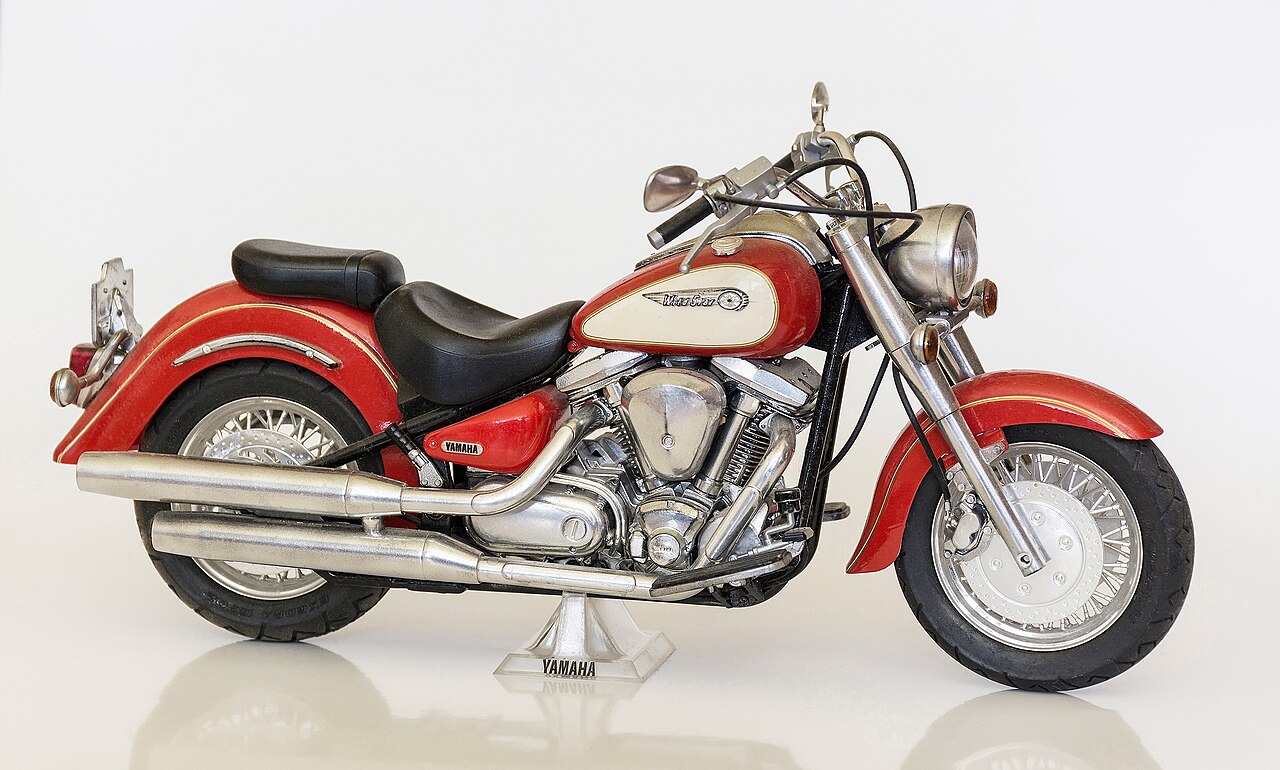
After World War II, Yamaha faced a pivotal crossroads. President Genichi Kawakami looked at the company's surplus wartime production machinery and its deep expertise in metallurgy and saw an unexpected opportunity: motorcycles. In 1954, the result was the YA-1, nicknamed Akatombo or Red Dragonfly, a 125cc single-cylinder two-stroke street bike. Only 125 units were built that first year, and the design drew on the German DKW RT 125, a machine that had also been copied by BSA and Harley-Davidson in the post-war period. The bike was named in tribute to founder Torakusu Yamaha. The modest but successful launch of the YA-1 led directly to the creation of Yamaha Motor Co., Ltd. in 1955, formally splitting the motorcycle division into its own independent company. Meanwhile, that same year 1954 also saw the founding of the Yamaha Music School.
Pioneers of Electronic Sound
Yamaha's influence on electronic music is hard to overstate. In 1977, the company released the CS-80, a polyphonic synthesizer. Then in 1983 came the DX7, which is widely regarded as the first commercially successful digital synthesizer. In 1988, the company became the first in the world to ship a CD recorder. The late 1990s brought the PSS and PSR lines of portable, battery-operated keyboards, with models like the PSS-14 and PSS-15 offering short demo songs, selectable phrases, and sound effects as upgrades to the earlier PSS-7. The SHS-10 Keytar brought MIDI output to a consumer price point, a feature previously reserved for far more expensive gear. In 2007, the YPG-625 earned both Keyboard of the Year and Product of the Year from The Music and Sound Retailer magazine.
A Global Web of Acquisitions
Yamaha's growth strategy has been as much about buying as building. In 1987, the company took a 51 percent majority stake in rival Korg, a holding that Korg eventually bought back in 1993. The following year, Yamaha acquired Sequential Circuits. In January 2005, it purchased German audio software house Steinberg from Pinnacle Systems. Perhaps the most symbolic move came in late 2007, when Yamaha agreed to buy all shares of Austrian piano maker Bösendorfer from BAWAG PSK Gruppe. The deal was announced in January 2008 after the NAMM Show in Los Angeles, and by February 1, 2008, Bösendorfer Klavierfabrik GmbH was operating as a Yamaha subsidiary, with manufacturing continuing at its Austrian facilities. In the UK, Yamaha consolidated its presence by buying out the Kemble family's minority stake in 2007, renaming the unit Yamaha Music U.K. Ltd.
Gallery
Frequently Asked Questions
Who is Yamaha Corporation?
Yamaha is a Japanese multinational company that builds musical instruments, audio equipment, semiconductors, and industrial machinery. It is widely recognized as the world's largest manufacturer of musical instruments and holds a spot on the Nikkei 225 index.
What products does Yamaha Corporation actually make?
Beyond its flagship pianos, guitars, and audio gear, the company also designs semiconductors and industrial machinery. This makes it a diversified manufacturer rather than a single-product brand.
How did Yamaha get its name?
The business started in 1887 under the name Nippon Gakki Co., Ltd., essentially meaning 'Japan Musical Instruments.' It rebranded to Yamaha Corporation in 1987, marking the centennial of its first commercially successful reed organ.
Why is Yamaha Corporation important to the global economy?
It dominates the musical-instrument manufacturing space in a way no other conglomerate does, giving it a unique niche in the industrial landscape. Its Nikkei 225 membership also underscores its significance within the broader Japanese market.
When was Yamaha Corporation founded and formally incorporated?
The company began operations in 1887 as a small reed-organ workshop and received its formal corporate incorporation on 12 October 1897. That puts its operating history at well over 135 years.
More in Corporations & Conglomerates 25-32
Related in Corporations & Conglomerates
Links follow this subject's own source article.
Elsewhere in the Corporations & Conglomerates universe
Spotted an error? Know more?
This is a living reference — every entry is fact-audited, and reader corrections feed straight into our audit queue. Suggest an edit · See this site's audit record